IPTV Reseller UK: How It Works
and What to Check First
An IPTV reseller buys access to a provider's service, usually as prepaid credits in a reseller panel, and sells logins to viewers under their own name, handling sales and support. The provider runs the servers and content. In the UK, check rights first: section 107 of the Copyright, Designs and Patents Act 1988 carries up to ten years for streaming copyright works to the public for gain without permission. Trading income over £1,000 means registering with HMRC, and holding customer data usually means an ICO fee.
Who wrote this
Flickhaven sells IPTV subscriptions, so we have an interest in this market. This guide is an explanation of the IPTV reseller model in the UK, not an offer. It quotes no wholesale prices or profit figures because no primary source publishes them. Legal and tax facts come from legislation.gov.uk and GOV.UK, checked on 3 November 2026. It is not legal or tax advice.

What an IPTV Reseller Is
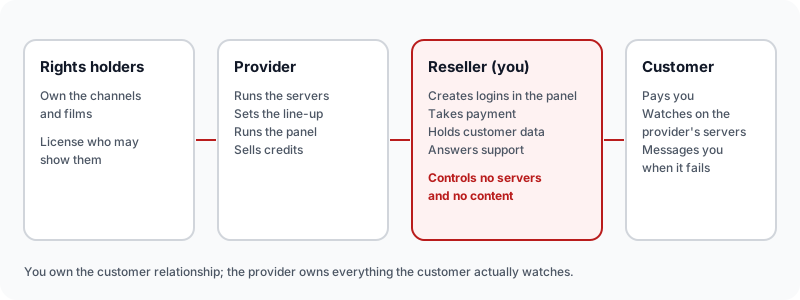
An IPTV reseller buys access to an IPTV service from a provider and sells it on to viewers under their own name, handling the sale and the support. The reseller runs no servers and owns no content. What they own is the customer relationship: the customer pays them, gets their login from them and messages them when something stops working.
That makes the model simple to describe and easy to underestimate. Everything the customer actually watches, from the channel list to the picture quality on a busy evening, is decided by a provider the customer has never heard of. If you are new to the technology itself, start with how IPTV delivers live TV over the internet.
How an IPTV Reseller Panel Works
An IPTV reseller panel is the provider's web dashboard. From it a reseller creates a login for each new customer, sets how long it runs, extends it on renewal and switches it off when the customer leaves. Panels are usually paid for with prepaid credits bought from the provider and spent as logins are created or extended.
How much a credit costs, how many a month of service uses, and whether unused credits expire are set by each provider. We found no primary source that publishes those terms, so this page does not quote a price or a margin, and any figure you see elsewhere is one seller's number. What every panel has in common is the dependency: the panel is only as good as the service behind it, and a provider that closes takes your customers' logins and your unspent credits with it.
The Legal Question Comes First
Anyone thinking about how to become an IPTV reseller in the UK should start with rights, not pricing. IPTV as a technology is legal; whether a particular service is lawful depends on whether it holds the rights to distribute what it streams, and our guide to how UK law treats IPTV services explains that distinction. A reseller sells that service for profit, so the question applies to them too. These are the four things to settle before your first sale.
Rights before anything else
Section 107(2A) of the Copyright, Designs and Patents Act 1988 makes it an offence to infringe copyright by communicating a work to the public, knowing or having reason to believe it infringes, with intent to make a gain or knowing it will cause the owner loss. Section 107(4A) sets the penalty: up to three months or a fine on summary conviction, up to ten years or a fine, or both, on indictment. The Digital Economy Act 2017 raised that maximum from two years to ten.
HMRC
The trading allowance covers the first £1,000 of gross trading income a year. Above it you must register for Self Assessment, by 5 October after the tax year, and declare the income on a tax return.
The ICO data protection fee
Businesses, organisations and sole traders that process personal data must pay the ICO a data protection fee unless they are exempt: £52 or £78 a year for most organisations. Customer names, phone numbers and payment records are personal data.
Written terms for your customers
Say what is being sold, for how long, on how many devices, and what happens if it stops working. Your customers will hold you to it, not the provider.
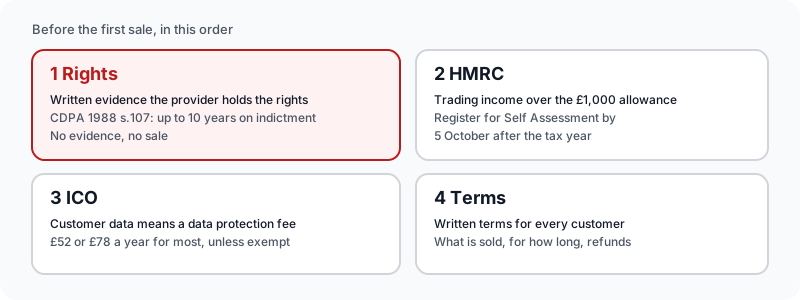
Nothing in section 107 limits the offence to whoever runs the servers. If a provider cannot show you written evidence of its rights, the safe answer is not to sell it, and a solicitor is the right person to judge any evidence it does give you.
Five Questions to Ask a Provider Before You Sign
Providers selling reseller access compete on channel counts and credit prices. Those are the wrong first questions. Ask these instead, and get the answers in writing.
Which rights do you hold?
Ask for written evidence that the provider may distribute the channels and films it streams in the UK. A screenshot of a channel list is not evidence of rights.
Who is the business?
A company name, an address and terms you can read before paying. If the supplier is only a phone number, you have no one to hold to the deal.
What happens when the service fails?
Customers will message you, not the provider. Ask how the provider reports outages and how quickly it answers resellers.
What happens to unused credits?
Credits are prepaid. Ask in writing whether they expire and what happens to them if the provider closes or changes its terms.
Can you test before you buy?
A test login on your own TV and broadband shows you what your customers will see.
The Part Most Guides Skip: Support
A reseller's day is mostly support. Customers need help installing a player app on a Firestick or a smart TV, entering their login, and working out why a channel buffers. When the provider has a problem, every affected customer messages the reseller at once, and the reseller can do nothing but wait and reply. Renewals have to be chased, and payments matched to logins by hand unless you build a system for it.
None of that shows up in a margin calculation, and it is the part that decides whether customers stay. Before you take money, decide when you will answer messages, what you will do when the service is down, and what your terms say about refunds. Our guide to what a viewer needs to set up IPTV is a fair picture of the questions you will be answering.
IPTV Reseller UK — FAQ
QWhat is an IPTV reseller panel?▼
It is the provider's web dashboard where a reseller creates customer logins, extends them when they renew and switches them off. Panels are usually paid for with prepaid credits bought from the provider. The servers, channels and streams stay with the provider; the panel only controls who can log in and for how long.
QIs it legal to be an IPTV reseller in the UK?▼
Only if the service you resell holds the rights to what it streams. Under section 107 of the Copyright, Designs and Patents Act 1988, communicating copyright works to the public without permission, knowing it infringes and to make a gain, is an offence carrying up to ten years on indictment. Ask the provider for written evidence of its rights before you sell, and take legal advice if it cannot give it.
QDo I need to tell HMRC about IPTV reseller income?▼
If your gross trading income is over the £1,000 trading allowance in a tax year, you must register for Self Assessment, by 5 October after the end of that tax year. Below £1,000 the allowance covers it. HMRC can charge a penalty if you register late.
QDo I need to pay the ICO as a reseller?▼
Probably. GOV.UK says businesses, organisations and sole traders that process personal data must pay the data protection fee to the Information Commissioner's Office unless exempt. It is £52 or £78 a year for most organisations. A reseller holds customer names, contact details and payment records, so check the ICO's self-assessment.
QDoes Flickhaven have a reseller programme?▼
No. Flickhaven has no reseller programme and sells subscriptions direct to viewers only. Treat any offer to resell Flickhaven as not coming from us.
Sources
- legislation.gov.uk — Copyright, Designs and Patents Act 1988, section 107
- legislation.gov.uk — Digital Economy Act 2017, section 32
- GOV.UK — Tax-free allowances on property and trading income
- GOV.UK — Register for Self Assessment if you're self-employed
- GOV.UK — Pay the data protection fee
Checked on .
Flickhaven Has No Reseller Programme
Flickhaven sells direct to viewers only. If you would rather watch than resell, ask us on WhatsApp which plan fits your devices.
Ask on WhatsApp